Skip to content

Mon–Sat: 8:00 AM – 10:00 PM (GMT)

Al Hussam Online Quran Academy logo markAl HussamOnline Quran Academy

ADVANCED QURANIC RECITATION

Online 10 Qirat Course for Advanced Quran Learners

Explore the ten canonical Qira’at through guided study of their recognized transmissions, recitation principles and applied differences. This advanced course is intended for learners with strong Quran reading and Tajweed foundations.

Level
Advanced
Suitable For
Huffaz & Advanced Readers
Main Subject
Ten Canonical Qira’at
Entry Requirement
Recitation Assessment
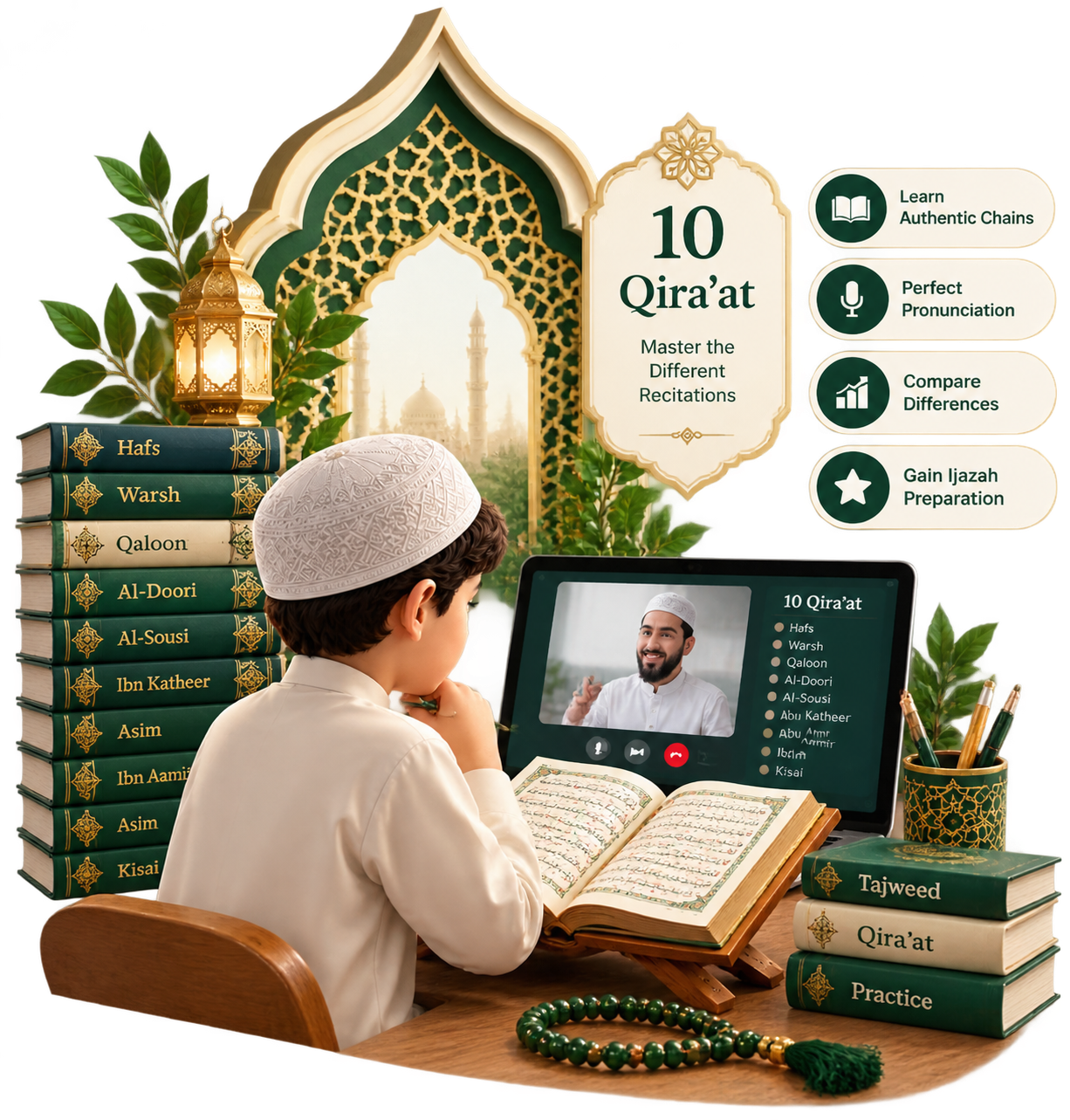
Advanced student studying canonical Quranic readings during an online lesson

COURSE OVERVIEW

What Are the Ten Qira’at?

The Ten Qira’at are the ten recognized canonical traditions of Quranic recitation transmitted through established scholarly chains. Each Qira’ah is associated with a recognized Imam of recitation and is commonly studied through two principal narrators or Riwayat.

The differences between the Qira’at follow transmitted recitation traditions. They may involve pronunciation, vowel treatment, elongation, assimilation, pausing and particular word forms. They are not independent Qurans or personal variations invented by individual reciters.

Studying Qira’at requires a strong foundation in Quran reading and Tajweed. Learners should normally be able to recite accurately in a recognized Riwayah, commonly Hafs ‘an ‘Asim, before beginning detailed comparative study.

  • Canonical Traditions

    Study recognized readings transmitted through established scholarly chains rather than personal variation.

  • Comparative Recitation

    Learn how transmitted differences appear in pronunciation, principles and particular Quranic words.

  • Advanced Entry

    Begin only after a strong Quran-reading and Tajweed foundation has been confirmed through assessment.

  • Supervised Application

    Practise under teacher guidance so readings are not mixed casually during recitation.

KEY TERMINOLOGY

Understanding Qira’ah and Riwayah

For example, ‘Asim is one of the ten canonical readers, while Hafs and Shu’bah are the two principal narrators commonly associated with his Qira’ah.

  1. Qira’ah

    A recognized reading tradition associated with an Imam of Quranic recitation.

  2. Riwayah

    A recognized transmission of a Qira’ah through one of its principal narrators.

  3. Tariq

    A transmission path through which a Riwayah was preserved and taught by later authorities.

  4. Qari

    A Quran reciter or specialist trained in Quranic recitation.

WHO CAN JOIN

Designed for Advanced Students of Quranic Recitation

The 10 Qirat Course is not an introductory Quran-reading program. Entry should be based on the learner’s recitation, Tajweed knowledge, previous study and ability to maintain a consistent advanced-learning schedule.

  1. Huffaz

    Learners who have memorized the Quran and want to expand their formal study of Quranic recitation.

  2. Quran Teachers

    Teachers seeking deeper knowledge of canonical readings and their recognized transmissions.

  3. Imams and Reciters

    Experienced reciters who already have strong Tajweed foundations and want structured comparative study.

  4. Advanced Tajweed Students

    Learners who recite confidently in one Riwayah and are ready to study additional transmitted readings.

  5. Students Continuing Previous Qira’at Study

    Learners who have already studied part of the Qira’at curriculum and require assessment before continuing.

PREREQUISITES

Are You Ready to Study the Ten Qira’at?

Because Qira’at is an advanced Quranic science, every prospective student should complete an initial assessment. The assessment helps determine whether the learner is ready to begin Qira’at study or should first strengthen Quran reading and Tajweed.

  1. Quran Reading Fluency

    The learner should be able to read Quranic Arabic confidently without relying on basic letter-by-letter guidance.

  2. Applied Tajweed

    The learner should understand and apply essential Tajweed rules during continuous recitation.

  3. Makharij and Sifaat

    Arabic letters should be pronounced with suitable attention to their articulation points and characteristics.

  4. Existing Riwayah

    The learner should normally have an established foundation in at least one recognized Riwayah.

  5. Study Discipline

    The learner should be prepared for regular revision, comparison and supervised recitation.

  6. Teacher Assessment

    Final eligibility and the appropriate starting point should be determined by a suitably qualified instructor.

Learners who still need stronger Quran reading or Tajweed foundations may be advised to begin with Quran Reading with Tajweed before advanced Qira’at study.

THE CANONICAL READINGS

The Ten Qira’at and Their Principal Riwayat

Each canonical Qira’ah is associated with a recognized reader and is commonly studied through two principal narrators. The following overview is educational and must be checked against Al Hussam’s actual teaching curriculum.

  1. Nafi‘ al-Madani

    Principal Riwayat: Qalun and Warsh

  2. Ibn Kathir al-Makki

    Principal Riwayat: Al-Bazzi and Qunbul

  3. Abu ‘Amr al-Basri

    Principal Riwayat: Al-Duri and Al-Susi

  4. Ibn ‘Amir al-Dimashqi

    Principal Riwayat: Hisham and Ibn Dhakwan

  5. ‘Asim al-Kufi

    Principal Riwayat: Shu‘bah and Hafs

  6. Hamzah al-Zayyat

    Principal Riwayat: Khalaf and Khallad

  7. Al-Kisa’i

    Principal Riwayat: Abu al-Harith and Al-Duri

  8. Abu Ja‘far al-Madani

    Principal Riwayat: Ibn Wardan and Ibn Jammaz

  9. Ya‘qub al-Hadrami

    Principal Riwayat: Ruways and Rawh

  10. Khalaf al-‘Ashir

    Principal Riwayat: Ishaq and Idris

This list, spelling, transliteration, ordering and inclusion in the actual course must be reviewed by Al Hussam’s qualified Qira’at instructor before publication. Do not assume that every Riwayah listed here is currently taught.

LEARNING OUTCOMES

What Advanced Students Can Study

These outcomes describe skills practised through supervised Qira’at study according to the confirmed curriculum. They do not promise mastery of all ten readings, scholarly authority or Ijazah through enrollment alone.

  1. Qira’at Terminology

    Develop an organised understanding of Qira’ah, Riwayah, Tariq and related study terminology.

  2. Principles of Each Reading

    Study recurring recitation principles associated with the readings included in the confirmed curriculum.

  3. Verse-Specific Differences

    Identify transmitted differences that occur in particular Quranic words and passages.

  4. Comparative Recitation

    Practise distinguishing and applying different readings under direct teacher supervision.

  5. Stronger Recitation Accuracy

    Receive correction in pronunciation, transmission-specific application and consistency.

  6. Structured Advanced Revision

    Develop a revision method for retaining the principles and applications already studied.

  7. Scholarly Study Foundations

    Build a stronger foundation for continued supervised study of Qira’at and their transmissions.

HOW QIRA’AT ARE STUDIED

Recurring Principles and Verse-Specific Differences

Students need both areas of study. Recurring principles provide an organised framework, while verse-specific applications require careful supervised learning and revision.

  1. Recurring principles

    Usul

    Usul refers to recurring principles or patterns associated with a particular reading or transmission. These may affect areas such as elongation, assimilation, Hamzah treatment or other recitation features.

    Focus

    • Madd variations
    • Hamzah treatment
    • Idgham
    • Imalah and Taqlil
    • Other transmission-specific patterns
  2. Verse-specific differences

    Farsh al-Huruf

    Farsh refers to transmitted differences associated with particular Quranic words or locations rather than one recurring general rule.

    Focus

    • Identifying relevant words
    • Comparing recognized readings
    • Memorizing verse-specific applications
    • Reciting within context
    • Teacher correction

ADVANCED CURRICULUM

How the Online 10 Qirat Course Progresses

The exact sequence depends on the teacher’s methodology, the learner’s existing Riwayah and the Qira’at included in Al Hussam’s verified curriculum. The following structure should be treated as a proposed learning framework.

  1. Phase 01 — Recitation and Tajweed Assessment

    Evaluate the learner’s current recitation, Tajweed application and readiness for advanced comparative study.

    • Current Riwayah
    • Quran recitation fluency
    • Makharij
    • Sifaat
    • Tajweed consistency
    • Memorization background
    • Study history
    • Recommended starting level
  2. Phase 02 — Foundations of Qira’at Study

    Introduce the terminology, organization and supervised study method required before comparing readings.

    • Qira’ah and Riwayah
    • Reader and narrator
    • Tariq and transmission
    • Canonical readings overview
    • Comparative notation
    • Study and revision method
    • Avoiding unauthorized mixing of readings
  3. Phase 03 — Usul: Recurring Principles

    Study recurring principles associated with individual readings or transmissions in the confirmed curriculum.

    • Madd variations
    • Hamzah treatment
    • Idgham
    • Imalah
    • Taqlil
    • Naql
    • Sakt
    • Pronoun treatment
    • Stopping principles
  4. Phase 04 — Farsh: Verse-Specific Applications

    Study transmitted reading differences associated with particular Quranic words and passages.

    • Identifying relevant words
    • Comparing recognized readings
    • Memorizing verse-specific applications
    • Reciting within context
    • Avoiding confusion between Riwayat
    • Teacher correction
  5. Phase 05 — Individual Qira’at and Riwayat

    Study the readings and principal transmissions included in the agreed learning plan.

    • Reader background
    • Principal narrators
    • Recurring rules
    • Verse-level applications
    • Guided recitation
    • Comparative review
    • Assessment before progression
  6. Phase 06 — Comparative Recitation Practice

    Apply the studied readings through supervised recitation while maintaining consistency within the selected Riwayah.

    • Selected surahs
    • Comparative recitation
    • Reading identification
    • Rule recall
    • Error correction
    • Transition discipline
    • Continued revision
  7. Phase 07 — Advanced Assessment

    Review the learner’s accuracy, consistency and understanding according to the instructor’s confirmed assessment method.

    • Oral recitation assessment
    • Rule application
    • Riwayah consistency
    • Comparative knowledge
    • Weak-area revision
    • Recommended continuation path

STUDY WITH DISCIPLINE

Common Challenges in Advanced Qira’at Study

Advanced Qira’at study depends on strong foundations, careful comparison and qualified supervision. These challenges are educational reminders, not detailed religious rulings.

  • Beginning Without Strong Tajweed

    Weak pronunciation foundations can make advanced differences more difficult to study accurately.

  • Confusing a Qira’ah with a Riwayah

    Students should understand the relationship between the canonical reader and the recognized narrators.

  • Mixing Readings Unintentionally

    Applications from different readings should not be combined casually during recitation.

  • Memorizing Rules Without Recitation

    Terminology and written rules require supervised oral application.

  • Progressing Without Revision

    Previously studied principles and verse-specific applications need consistent review.

  • Learning Without Qualified Supervision

    Advanced Qira’at study depends on oral instruction and correction from a suitably qualified teacher.

Keep comparative study under teacher guidance. Applications from different readings should not be combined casually during recitation.

LEARNING EXPERIENCE

How Advanced Online Qira’at Lessons Work

Live online lessons combine explanation, listening, supervised recitation and organised revision so advanced differences can be applied carefully.

  1. Confirm the Reading

    The teacher identifies which Qira’ah and Riwayah the learner is currently studying.

  2. Study the Principle, Listen and Compare

    A recurring rule or verse-specific application is explained using appropriate examples. The learner listens carefully and distinguishes it from previously studied readings.

  3. Recite Under Supervision

    The learner applies the reading while the teacher corrects pronunciation and consistency.

  4. Record and Revise

    Rules, examples and corrections are organised for revision before the next lesson.

YOUR QURAN JOURNEY

Build Recitation Strength Before Advanced Qira’at

The 10 Qirat Course is an advanced pathway. Learners who still need stronger reading, Tajweed or memorization foundations may begin with an earlier course before comparative Qira’at study.

  1. Quran Reading with Tajweed

    Strengthen fluency, pronunciation and applied Tajweed foundations.

  2. Quran Memorization

    Build sustained memorization and revision habits where relevant.

  3. Online 10 Qirat

    Study canonical readings through supervised comparative recitation.

    Current course

Request an Advanced Recitation Assessment

Tell us about your Quran recitation, Tajweed background, memorization and previous Qira’at study. Al Hussam will help determine whether this advanced course matches your current level.

10 QIRAT COURSE FAQ

Questions About Studying the Ten Qira’at Online

Open book for Quran Memorization
Developing to AdvancedKids, Teenagers & Adults

Quran Memorization

Follow a structured Hifz plan combining new memorization, revision and consistent teacher guidance.

  • Personalized memorization plan
  • Daily revision structure
  • Progress-based lesson planning
Open book for Online Islamic Studies Course
Beginner to ContinuingKids, Teenagers & Adults

Online Islamic Studies Course

Develop clear Islamic knowledge through age-appropriate lessons covering belief, worship, Seerah, Hadith, manners and history.

  • Aqeedah and essential beliefs
  • Worship and everyday practice
  • Seerah, Hadith and manners

ADVANCED QURAN STUDY

Find Out If the 10 Qirat Course Is Right for You

Share your recitation background and previous study with Al Hussam to request an assessment for this advanced Quranic recitation course.